
A 3000W marine inverter is one of the most popular power solutions for modern boats, yachts, sailboats, and fishing vessels. By converting DC battery power into stable household AC electricity, a 3000W boat inverter allows boat owners to run refrigerators, navigation equipment, communication systems, microwaves, coffee makers, and other onboard appliances.
Whether you’re designing a recreational vessel, upgrading a yacht electrical system, or building a commercial marine power solution, a properly sized 3000W marine inverter system provides reliable AC power both near shore and during extended off-grid operation.
In this guide, we’ll explain what a 3000W DC to AC marine inverter can run, how to size batteries correctly, how to integrate solar charging, and how to build a safe and efficient marine power system.
To better understand inverter specifications, battery requirements, surge capacity, and system design, see our complete 3000W Pure Sine Wave Inverter Guide.
Why Choose a 3000W Marine Inverter for Your Boat?
For many boats, 3000 watts represents the ideal balance between power capacity and system efficiency.
Compared with smaller inverters, a 3000W model allows multiple appliances to operate simultaneously without exceeding the inverter’s continuous output rating.
Typical marine applications include:
- Marine refrigerators and freezers
- Microwave ovens
- Coffee makers
- Satellite internet systems
- Navigation electronics
- Battery chargers
- Televisions and entertainment systems
- Small marine air conditioners
- Maintenance power tools
This makes a 3000W inverter suitable for both recreational and professional marine environments.
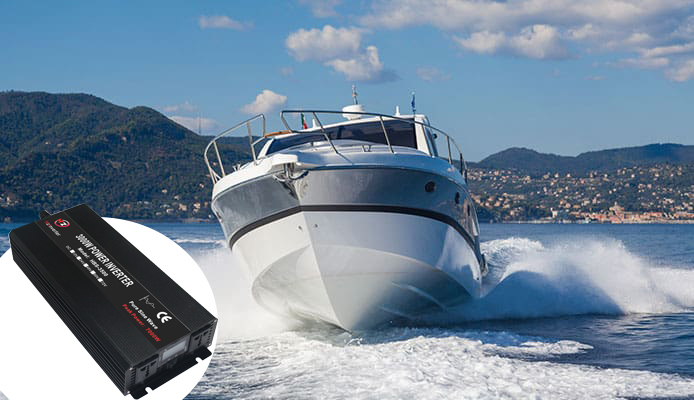
Typical Boats Using a 3000W Marine Inverter
A 3000W inverter is commonly installed in:
Fishing Boats
Supports refrigeration, lighting, navigation systems, communication equipment, and battery charging.
Sailboats
Provides quiet AC power without relying heavily on generators during long-distance cruising.
Cabin Cruisers
Powers kitchen appliances, entertainment systems, and overnight comfort loads.
Catamarans
Works well with larger battery banks and solar charging systems.
Yachts
Provides reliable backup power and supports luxury onboard amenities.
Commercial Workboats
Supports tools, chargers, communication equipment, and operational electronics.
Common Marine Loads Supported by a 3000W Inverter
One of the most common questions from boat owners is how much equipment a 3000W inverter can realistically power.
| Marine Appliance | Running Watts |
|---|---|
| Refrigerator | 150-300W |
| Microwave | 1200-1500W |
| Water pumps | 800-1200W |
| Starlink System | 50-100W |
| Navigation Equipment | 50-200W |
| Fish finders | 60-150W |
| LED Lighting | 20-100W |
A properly sized 3000W inverter can run several of these loads simultaneously.
For a complete appliance breakdown, see: What Can a 3000W Inverter Run?
Marine Environment Challenges for Inverter Systems
Unlike RVs or home backup systems, marine electrical equipment operates in one of the harshest environments possible. Salt air, humidity, vibration, and constant movement can significantly affect inverter performance and lifespan.
Saltwater exposure accelerates corrosion on terminals, connectors, and circuit boards. Even small amounts of moisture can cause oxidation that increases resistance and generates excess heat. Boats also experience continuous vibration from engines and wave motion, which can loosen wiring connections over time.
For these reasons, marine inverter installations should always use marine-grade cables, corrosion-resistant terminals, and properly sealed electrical enclosures. Adequate ventilation is also critical, as inverter electronics generate heat during operation and require airflow to maintain efficiency.
When selecting a 3000W marine inverter, durability is often just as important as power output. Choosing equipment designed specifically for marine environments can improve reliability and reduce maintenance requirements during long voyages.
Pure Sine Wave vs Modified Sine Wave for Marine Electronics
Modern boats rely heavily on sensitive electronic equipment. Navigation systems, GPS chart plotters, radar units, fish finders, communication radios, and battery chargers all require clean and stable AC power.
While modified sine wave inverters are generally less expensive, they can introduce electrical noise that interferes with sensitive electronics. Some devices may run hotter, operate less efficiently, or fail to function correctly when powered by a modified waveform.
A 3000W pure sine wave inverter produces electricity that closely matches utility-grade shore power. This makes it the preferred choice for yachts, cruising boats, and fishing vessels that depend on reliable electronic systems.
In addition to protecting navigation equipment, pure sine wave power also improves the performance of refrigerators, microwaves, induction cooktops, and air conditioning systems commonly found onboard larger vessels.
3000W Marine Inverter Startup Surge Requirements
Many marine appliances require significantly more power during startup than during normal operation.
Examples include:
| Equipment | Running Watts | Startup Surge |
|---|---|---|
| Refrigerator | 200W | 800-1200W |
| Freezer | 300W | 1000-1500W |
| Air Conditioner | 1200W | 3000-5000W |
| Circular Saw | 1500W | 3000-3500W |
When selecting an inverter, both continuous output power and surge capability must be considered.A high-quality 3000W marine inverter typically provides up to 6000W peak surge capacity.
For compressor-based equipment, see:3000W Inverter for Air Conditioners & Compressor Loads
Marine Battery System Design for a 3000W Inverter
A 3000W marine inverter can provide reliable AC power for onboard appliances, navigation equipment, galley devices, and entertainment systems. However, inverter performance depends heavily on the design of the battery system. Selecting the correct battery voltage, battery capacity, and wiring configuration is essential for efficiency, runtime, and long-term reliability.
Choosing Between 12V, 24V, and 48V
A 3000W inverter can operate on 12V, 24V, or 48V battery systems, but each voltage level offers different advantages.
A 12V system is common on smaller boats and fishing vessels because it is compatible with existing marine electrical systems. However, at full load, a 3000W inverter may draw more than 250 amps from the battery bank. Such high current requires very large cables and can result in greater voltage drop.
A 24V system is often the preferred choice for medium-sized boats and cruising yachts. By doubling the system voltage, current is reduced by approximately half, improving efficiency and reducing cable size requirements. Many marine installers consider 24V the best balance between performance and installation cost for 3000W inverter systems.
A 48V system is typically used on larger yachts and vessels with substantial electrical demands. The lower current flow improves efficiency and simplifies wiring, particularly when inverter loads operate for extended periods.
For most boats using a 3000W inverter, a 24V battery system is generally the most practical solution.
Battery Capacity and Runtime Calculations
Battery capacity determines how long the inverter can operate before recharging becomes necessary.
For example, if onboard equipment consumes 1500 watts continuously, the system will require approximately 1500 watt-hours of energy for every hour of operation. A vessel running refrigeration, electronics, lighting, and occasional galley appliances may consume several kilowatt-hours during a day at anchor.
When designing battery capacity, boat owners should consider:
- Expected daily energy consumption
- Duration between charging opportunities
- Battery depth of discharge limits
- Available charging sources such as alternators, shore power chargers, or solar panels
Lithium batteries are becoming increasingly popular in marine applications because they provide higher usable capacity, faster charging, and reduced weight compared to traditional lead-acid batteries.
As a general guideline, vessels relying heavily on inverter power should size the battery bank based on daily energy requirements rather than inverter wattage alone.
Recommended Battery Configurations
The optimal battery configuration depends on the vessel type and intended use.
Weekend Fishing Boats
- 12V or 24V system
- Moderate battery capacity
- Suitable for electronics, lighting, and occasional appliance use
Cruising Sailboats
- 24V system
- Larger battery bank for overnight anchoring
- Often combined with solar charging systems
Liveaboard Yachts
- 24V or 48V system
- High-capacity lithium battery bank
- Designed to support refrigeration, entertainment systems, and daily household-style power consumption
Regardless of vessel size, batteries should be installed in properly ventilated compartments and connected using marine-grade cables and corrosion-resistant terminals. Proper system design not only improves inverter performance but also enhances safety and reliability in demanding marine environments.
Continuous Cruising vs Weekend Boating Power Requirements
Not all boats have the same energy demands. A weekend recreational boat may only require occasional inverter use for small appliances and electronic devices, while a liveaboard yacht or long-range fishing vessel may depend on inverter power for many hours each day.
Weekend boaters typically focus on short-duration loads such as microwave ovens, coffee makers, televisions, and charging stations. In these applications, battery capacity requirements are relatively modest.
Continuous cruisers and liveaboard vessels often power refrigerators, freezers, communication equipment, lighting systems, entertainment devices, and galley appliances for extended periods. These installations usually require larger battery banks, higher charging capacity, and often supplemental solar power systems.
Understanding your boating style is one of the most important factors when sizing a 3000W marine inverter system. The inverter itself may be identical, but battery storage and charging requirements can vary dramatically depending on how the vessel is used.
Integrating Solar Power on Boats
Modern marine electrical systems increasingly combine:
- Solar panels
- MPPT charge controllers
- Lithium batteries
- Pure sine wave inverters
Benefits include:
- Reduced generator runtime
- Lower fuel consumption
- Quiet operation
- Increased energy independence
Typical system configuration:
- 600W–2000W Solar Panels
- MPPT Solar Controller
- 24V or 48V Battery Bank
- 3000W Pure Sine Wave Inverter
For detailed solar system design, see: 3000W Off-Grid Solar Power Setup
Marine Safety Standards and Installation Considerations
Marine environments present unique challenges including vibration, moisture, salt-air corrosion, and temperature fluctuations.
ABYC Electrical Compliance
Marine electrical installations should follow American Boat and Yacht Council (ABYC) guidelines.
Proper AC grounding and neutral bonding practices are essential for safe operation and GFCI protection.
Ignition Protection
If an inverter is installed near:
- Fuel tanks
- Gasoline engines
- Propane systems
it should comply with ignition protection requirements to reduce explosion risks in hazardous environments.
Marine-Grade Components
Recommended installation practices include:
- Marine-grade cabling
- Proper DC fusing
- Circuit breakers
- Battery disconnect switches
- Corrosion-resistant terminals
- Adequate ventilation
These measures improve both safety and long-term reliability.
Shore Power and Automatic Transfer Switching
Many boat owners require seamless switching between shore power and inverter power.
A marine inverter with an integrated Automatic Transfer Switch (ATS) can:
- Detect shore power availability
- Automatically transfer loads
- Minimize interruption to onboard equipment
This provides a UPS-style experience for critical systems such as:
- Navigation electronics
- Communication equipment
- Network systems
- Refrigeration
OEM Marine Inverter Solutions for Boat Builders
Boat manufacturers, marine distributors, and system integrators often require solutions beyond standard retail products.
OEM and ODM customization options may include:
- Custom AC output configurations
- CAN Bus communication
- NMEA 2000 integration
- Remote monitoring systems
- Waterproof enclosures
- High surge capability
- Private labeling and branding
Our engineering team works with marine equipment manufacturers worldwide to develop customized inverter solutions for recreational and commercial vessels.
Marine applications are only one of the many uses for a 3000W inverter. To explore battery sizing, surge requirements, off-grid systems, and appliance compatibility in greater detail, read our complete 3000W Pure Sine Wave Inverter Guide.
To better understand complete system design, explore our related resources:
- What Can a 3000W Inverter Run?
- 3000W Home Backup Power System
- 3000W Off-Grid Solar Power Setup
- 3000W Inverter for Air Conditioners & Compressor Loads
- 3000W Surge Power & Starting Load Guide
Conclusion
A 3000W marine inverter system provides reliable AC power for refrigerators, navigation systems, communications equipment, galley appliances, and many other onboard loads.
When combined with a properly sized battery bank, optional solar charging system, and marine-grade electrical protection, a 3000W pure sine wave inverter can deliver dependable power for fishing boats, sailboats, yachts, and commercial vessels operating both near shore and off-grid.